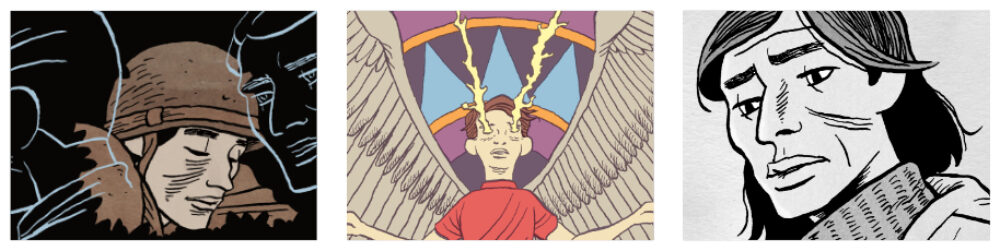
I’ve been a big fan of Lynd Ward for years now. The most money I’ve ever spent on a book was to obtain his long out-of-print Storyteller Without Words. You can read a bit about Ward through the Wikipedia link above, but basically he was a woodblock artist in the early twentieth century who was inspired by Franz Masereel and Otto Nückel to create woodblock novels. Today we’d call them graphic novels, but the term didn’t exist then. While I like Masereel’s boldness, I’ve always preferred the sensitivity I saw in Ward’s work. Sometimes his political views could overpower his work, but his visual storytelling was surprisingly complicated, even by today’s standards. Ward had an incredible ability to render abstract thoughts visually. For instance, the first six panels of “Prelude to a Million Years” alludes to the struggle of art to search for truth in the midst of the other aspects of culture (religion, science…), while then leading into the desires of the main character to render this platonic notion of beauty in sculpture. Simply wonderful stuff.
And out of print. Luckily, Dover is gradually reprinting Ward’s early woodcut novels, God’s Man, The Madman’s Drum, and Wild Pilgrimage. But Ward’s other work is not readily available. Wild Pilgrimage also appears in Graphic Witness and Wordless Books: The Original Graphic Novels has a Ward piece. But his later work is hard to find.
About six years ago I made a exciting discovery: I found a version of Frankenstein illustrated by Lynd Ward. I loved how he depicted the monster. It was huge, with sagging yet menacing limbs. So I scanned my favorite bits since the book I found was in the San Jose State University library. Well, I just found these scans again while looking for something else on an old cd. I decided to post them here. Again, as far as I know, these images are out of print, which is a shame. Also, I didn’t know much about scanning six years ago. So these images are a bit small and not as sharp as I’d like. Still, I think they’re simply wonderful. Ward creates an incredible sense of atmosphere. And notice how he uses the shape of the illustration to accent the height of the monster and, later, its weight.


**edit, September 7, 2009** The images besides the cover and title page have been removed, because Dover has put this book back into print.
Gorgeous post. Thanks. Can you tell from your initial scans what type of print making this is? It looks different from other stuff of his I’ve seen. It brings out a likeness between his work and the work of Thomas Hart Benton that I never noticed before.
Come now. This is one of those posts that has “sweeps the internet” written all over it. Where are the connoisseurs?
These images are all woodblock prints. I’m not sure the process the publishers used to mass print the book. A few of the Frankenstein illustrations appear in Storyteller Without Words, but they’re overinked (unfortunately).
Ward progressed a lot over the years. God’s Man has the same elongated forms as in the images above, but Ward’s knowledge of figure was not as strong in that book. Also, the images are done in a more traditional woodblock style. Later in his career, Ward was able to vary the types of marks he made (as evidenced above). By the time of his final woodblock novel, Vertigo (1937), Ward was capable of producing soft light effects and subtler forms of shading than one expects from woodblock. The sharp lined shading that you can see all throughout God’s Man and Madman’s Drum is almost completely absent in Ward’s later work. He really was a master craftsperson.
He mastered his craft alright! The comparison with God’s Man is an illustration of imaginative technical development.
I work for Georgetown University as a photographer and recently got to photograph Lyn Ward’s woodblocks for God’s Man that are in our Special Collections Division. We have a huge collection of Ward prints and original blocks and tools and they are all a wonder to look at!
These are really wonderful. Thanks for posting.
@David Hagen: is any of Georgetown’s collection available for viewing online?
I don’t know when I’ll be in D.C., but if ever I am I’m definitely going to visit. Are the special collections open to everyone or just researchers associated with a university?
Here are some Georgetown links of Lynd Ward info and some images:
http://www.library.georgetown.edu/dept/speccoll/guac/ward_05/wordless.htm
http://www.library.georgetown.edu/dept/speccoll/lynd_ward/illustrations.htm
And I just did a quick search, and John Lauritsen has some images of the book up on his site:
http://paganpressbooks.com/jpl/LYNDWARD.HTM
He also has an entire book attempting to show that Percy Bysshe Shelley wrote Frankenstein and not Mary, which is a bold claim and may be a book I’ll have to pick up.
I’ve got this book – inherited it from my grandfather – it’s absolutely lovely.
Wow! Just wow! Thanks for sharing.
Lynd Ward’s wood engravings started me on a journey that resulted in my book: Wordless Books: The Original Graphic Novels. I spent a lot of hours at Georgetown’s Special Collections and have to echo David Hagen’s comment. It is WELL WORTH a visit.
For those further interested in Ward, I was at exhibit at Rutgers a few years ago with Ward’s blocks from VERTIGO. Check this out online:
http://www2.scc.rutgers.edu/Vertigo/
VERY cool! Thanks for sharing.
Centipede Press (www.centipedepress.com) has recently issued a collector’s edition of FRANKENSTEIN with Lynn Ward’s artwork. It’s priced for collectors ($225, clothbound hardback in slipcase), but it’s simply magnificent and, like all of their books, issued in a very small print run.
Centipede Press’s magnificent anthology of HP Lovecraft art (400+ pages, introduction by Harlan Ellison, oversized at 12 x 15.5 inches, and slipcased, with a Michael Whelan wraparound jacket) is no doubt THE most collectible book of the year. You can get it in hardback with dust jacket without the slipcase for $225, but collectors will probably want the slipcased edition ($395) and, for the well-heeled, the traycased edition with extra prints ($495). I doubt most people could afford the leather in traycase edition at $2495, but it’s available if you’ve got great taste and a budget to match.
Bottom line: If you want a collectible, beautiful, book-for-the-ages edition of FRANKENSTEIN, look no further: Centipede Press has delivered the edition of choice for $225.
[...] coincidence strikes again. A year ago I posted some images that Lynd Ward did for an edition of Frankenstein. And a few months ago I got a a printing of the [...]
how much would any of Lynd Ward’s original books be worth?
I’m not sure how you would get his original printings of his books. But the collection Storyteller Without Words which came out in 1974 cost me about $225.